
Green Energy Conversion for the Future of Earth
Currently, renewable energy sources account for 26% of the world's power, but the IEA predicts that by 2024, this percentage will rise to 30%. The comeback followed a worldwide downturn in 2019

Chapter 1:- The Future of Renewable Energy: Growth Projections
Currently, renewable energy sources account for 26% of the world's power, but the IEA predicts that by 2024, this percentage will rise to 30%. The comeback followed a worldwide downturn in 2019, which was caused by declining technology prices and growing environmental concerns.
It is anticipated that by 2024, the global solar capacity would increase by 600 gigawatts (GW), almost double Japan's installed total power capacity. Overall, renewable power is expected to increase by 1,200 GW by 2024, which is like the United States' entire electrical capacity.
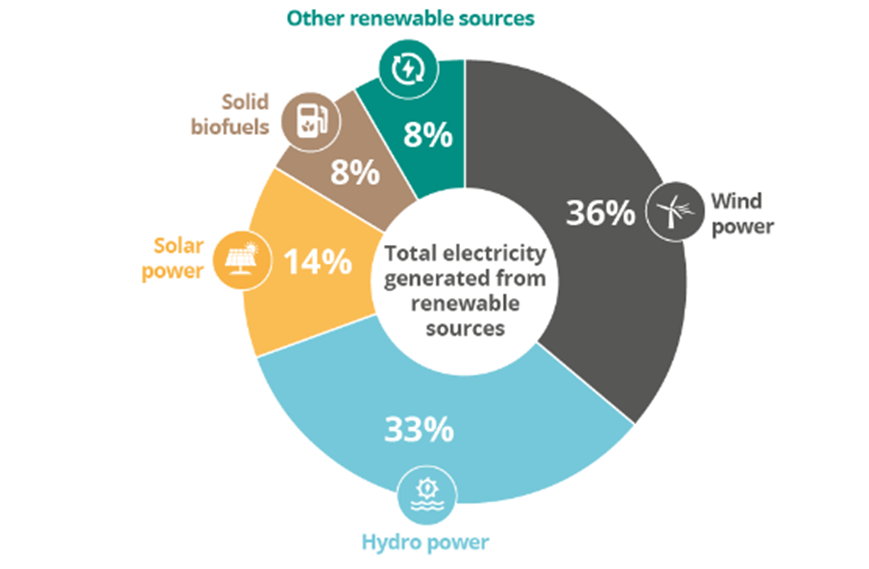
Wind and hydro power accounted for more than two thirds of the renewable energy produced in the EU in 2020, according to Eurostat statistics (36% and 33%, respectively). The remaining third was comprised of solar energy (14%), solid biofuels (8%), and other renewable sources (8%).
Chapter 2:- By the year 2024, solar panels will have decreased in price by 35%.
When sunlight strikes a solar panel, the PV cells inside the panel absorb the sun's energy. This energy generates electrical charges that move in reaction to the cell's internal electrical field, resulting in the flow of electricity.
Industry analysts expect that the number of solar installations in the United States will treble to four million by 2023. In 2018, the United Kingdom surpassed one million solar panel installations, a 2% increase from the previous year, while Australia achieved two million solar panel installations in the same year. The decrease in installation costs is a significant factor in this growing adoption.
In 2018, the cost of solar PV-based energy decreased by 13%, while Carbon Tracker projects that 72% of coal-based energy would become unprofitable worldwide by 2040. According to the IEA analysis, solar energy will account for 60% of the expected rise in renewable energy, mostly owing to its accessibility.
Solar Energy Capacity in the Future
Since the sun rises and sets on a regular schedule, solar power is more flexible than wind or hydropower, which require consumers to be in specified places. Currently at 58 GW in 2018, residential solar power is projected to grow to 142 GW by 2024, with annual capacity additions tripling to over 20 GW. By 2024, China is projected to have the most residential solar capacity, with Australia, Belgium, the Netherlands, and Austria showing the best increase on a per capita basis.
By storing energy during the day and using it at night, solar installations will continue to reduce their fluctuation rates. However, modern solar power plants will run at greater DC-to-AC ratios, allowing them to provide more constant service over longer periods of time. Also, in the near future renewable energy sources will be grown rapidly apart with solar.
Chapter 3 :- By 2024, hydroelectric capacity will increase by 9%.
Hydroelectric plants convert the energy of falling water into electricity. The kinetic energy of falling water is converted into mechanical energy by a turbine. The mechanical energy from the turbine is then converted to electrical energy by a generator.
According to the International Energy Agency, hydropower will continue to be the world's largest source of renewable energy in 2024. Over the predicted period, capacity is expected to expand by 9% (121 GW), driven by China, India, and Brazil. Only three megaprojects are anticipated to provide 25% of worldwide growth: two in China (the 16 GW Wudongde and 10 GW Baihetan projects) and one in Ethiopia (the 6.2 GW Grand Renaissance project).
However, growth is threatened by rising investment costs due to limited remaining economical sites and extra expenditures in addressing social and environmental impacts, especially in China and Brazil, the world's two largest markets.
Renewable Energy Is the Way of the Future
The use of renewable energy sources is expected to increase over the next decade, surpassing those of fossil fuels while simultaneously lowering emissions of greenhouse gases.
Fatih Birol,director general of the International Energy Agency, has observed,
"This is a key moment for renewable energy." Changes in the world's energy infrastructure are being driven by innovations like solar and wind power. The fight against climate change, air pollution, and the lack of access to electricity all depend on their widespread implementation.
References
A future based on renewable energy. 2022. Available at: https://www.eea.europa.eu/signals/signals-2022/articles/a-future-based-on-renewable-energy [Accessed: 6th January 2023].
Decarbonizing the energy system by 2050 could save trillions. 2022. Available at: https://www.inet.ox.ac.uk/news/decarbonising-the-energy-system-by-2050-could-save-trillions/ [Accessed: 4th January 2023].
More..
Global energy demand to grow 47% by 2050, with oil still top source: US EIA. 2021. Available at: https://www.spglobal.com/commodityinsights/en/market-insights/latest-news/oil/100621-global-energy-demand-to-grow-47-by-2050-with-oil-still-top-source-us-eia [Accessed: 2nd January 2023].
Renewable Energy Conversion Systems. 2020. Available at: http://www.sciencedirect.com:5070/book/9780128235386/renewable-energy-conversion-systems [Accessed: 3rd January 2023].